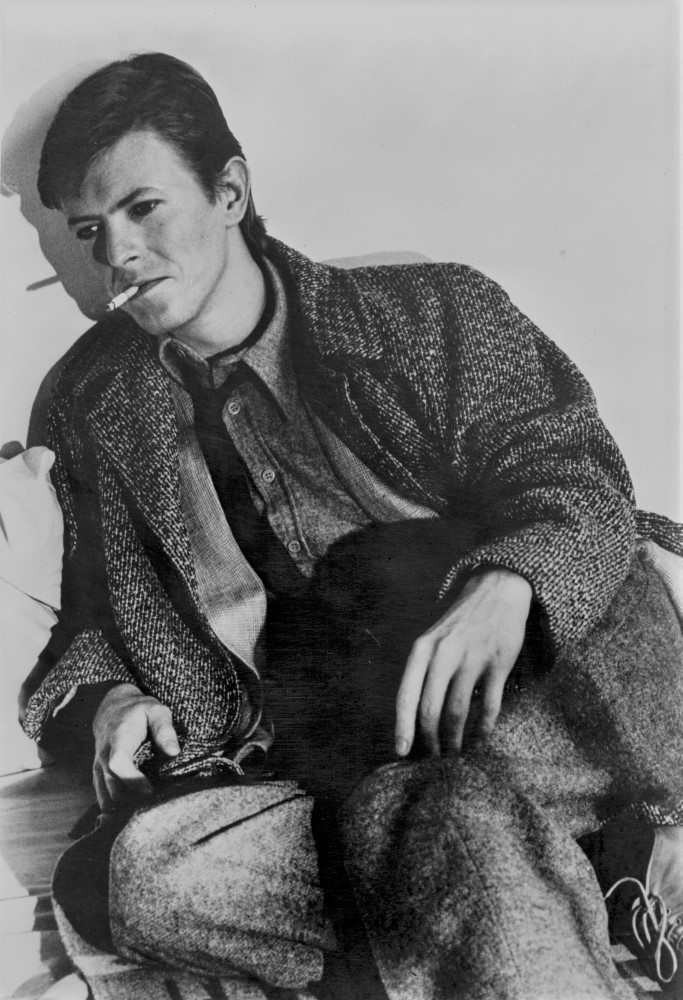
There’s a moment in 1976 when David Bowie, fresh off his cocaine-fueled lost weekend in LA with fellow confederates John Lennon and Harry Nilsson, steps off a train at Berlin’s Zoo Station wearing a simple black suit, white shirt, and thin black tie. Gone are the glitter boots, the flame-red mullet, and Kabuki inspired costumes that made Ziggy Stardust a household name. In their place: the uniform of a man seeking anonymity in a divided city. Far from the fame he once chased, he was hoping to find a place where he could be anonymous and blend in with his environs
The music he was making took a radical departure too, with its influences coming from the German school of avant rock being played by Tangerine Dream, Can, and Neu with its motorik rhythms and use of synthesizers as he searched for a new sound. He was also quite taken by everyone from modern classical composers such as Philip Glass and Steve Reich to rockers like Iggy Pop and Lou Reed, who became became close collaborators at this time. I saw him live back then, playing keyboards for Iggy. He wore a drab flannel shirt, left his hair dye at home, and refused to share the spotlight or the limelight with Iggy. But when his backing vocals came over the sound system, there was no mistaking who was up on stage. But I digress, perhaps the biggest impact came from Brian Eno. Having left Roxy Music, he was just beginning to make a name for himself as a producer, working with Ultravox and Devo. And Eno was just the person needed to add an element of unpredictability to Bowie’s sound.
Bowie went to Berlin to reinvent himself and his music. It’s fair to say that he was a bit desperate. His personal life was in a bit of a shambles due to to his coke habit and he was lost for a musical direction. He needed to bury Ziggy once and for all and move on. With Eno on board and Iggy coming along for the ride, he felt free to experiment. The period of 1976-1979 saw the release of the Berlin Trilogy, which many people now consider the pinnacle of his musical career
Looks wise, he went from a heavily made-up glam peacock (who once wore a dress on an album cover) to to a stripped down monochromatic approach that put the emphasis on established tailoring norms but pushed that extra bit with strong shoulders, jackets that were nipped in at the waist, and a return to 1930s and 1940s costumes like baggy high waisted trousers and camp shirts. For the first time, what he wore offstage was the same as what he wore while performing or in photo shoots. He could be seen around Berlin in the overcoat he wore on the cover of Low which made him look like a character from a Fritz Lang film. As ever a keen student of the arts, Bowie absorbed the visual language of the Expressionists. His silhouettes became more geometric, his color palette more severe.
From all accounts it appeared that the Starman had fallen to earth. It was a bit of a crash landing, let’s be honest. But Bowie was able to put the pieces together and emerge stronger than the sum of his parts.
Bowie’s Berlin era minimalism wasn’t about playing it safe. It was about creating maximum impact with minimal effort so as to appear like it was effortless, when in fact it was nothing of the sort. Every element was considered, every detail weaponized. The suits were cut close to his rail-thin frame, emphasizing his alien proportions rather than hiding them. His embrace of earlier eras wasn’t conservative. Instead it made him seem even more futuristic.
His Berlin years proved that minimalism isn’t about having less—it’s about needing less because what you have is exactly right. It’s a lesson that most of menswear is still trying to learn, forty-five years later.